Hotline: +84 981638588
Email: info@lochoangan.com No. 105 Hoang Van Thai Street, Phuong Liet Ward, Ha Noi, Vietnam
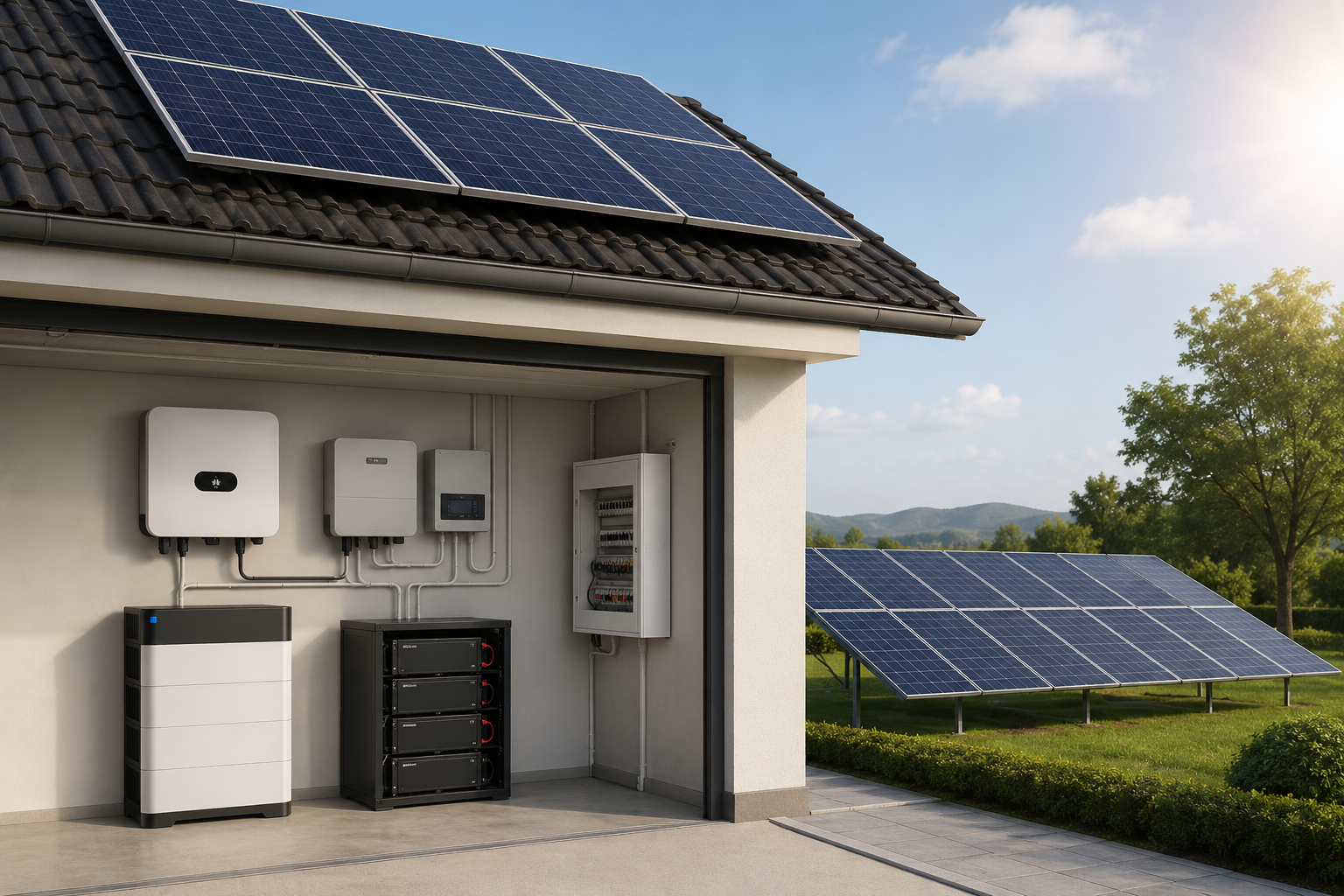
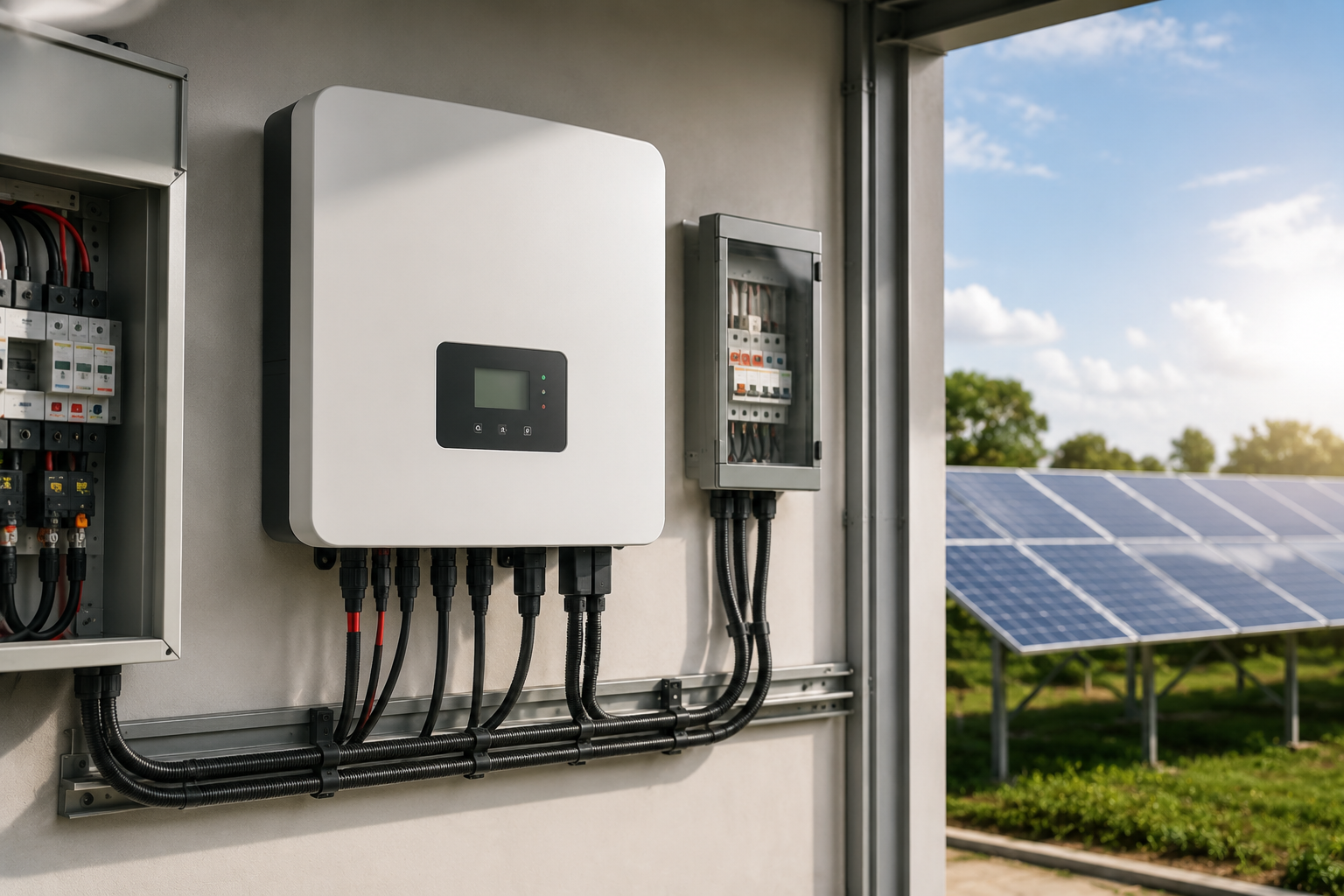
A solar inverter is one of the most important components of a solar power system. It converts the direct current (DC) generated by solar panels into alternating current (AC) to power electrical equipment, feed electricity into the grid, or work with battery storage.
Choosing the right inverter directly affects conversion efficiency, system performance, safety, and future expansion capabilities.
A solar inverter, also known as a solar power converter, converts DC electricity from solar panels into AC electricity. AC power is commonly used in residential, commercial, industrial, and grid-connected electrical systems.
According to the U.S. Department of Energy, photovoltaic panels generate DC electricity, while inverters convert it into AC power for local consumption or grid integration.
Modern inverters can also perform several additional functions, including:
Maximum Power Point Tracking (MPPT)
Output voltage and frequency regulation
Grid synchronization
Electricity generation monitoring
Fault detection and system protection
Battery charging and discharging management
Power source switching during grid outages
Remote monitoring through management software
Solar panels absorb sunlight and generate DC electricity, which travels through DC cables to the inverter.
The inverter uses power electronic components to convert DC electricity into AC power with suitable voltage, frequency, and waveform characteristics. The converted electricity is then supplied to connected loads, exported to the grid, or coordinated with an energy storage system.
The basic operating process includes:
Solar panels generate DC electricity.
The inverter receives power from the solar panel strings.
The MPPT controller identifies the optimal operating point.
The inverter converts DC electricity into AC power.
AC electricity supplies loads or is fed into the grid.
The monitoring system records energy production and operating status.
For hybrid inverters, the device also manages energy flows between solar panels, batteries, electrical loads, and the utility grid according to the configured operating mode.
This is the inverter's primary function. DC electricity from solar panels cannot directly power most conventional electrical appliances. The inverter converts it into AC electricity for use in homes, offices, and factories.
Sunlight intensity and temperature change throughout the day, causing solar panel voltage and current to fluctuate.
Inverters use Maximum Power Point Tracking (MPPT) to adjust the operating point of solar panel strings and maximize energy harvesting under changing sunlight conditions.
Inverters with multiple MPPT inputs are often suitable for installations with different roof orientations, tilt angles, or shading conditions.
Grid-tied inverters regulate output voltage, frequency, and phase to match the utility grid. Solar electricity can supply loads and connect to the existing electrical network only when the required parameters are within acceptable limits.
If the grid becomes abnormal or loses power, conventional grid-tied inverters shut down to maintain safety. Therefore, standard grid-tied systems without backup capabilities generally cannot continue supplying electricity during grid outages.
Depending on the model, an inverter may integrate or work with protection functions such as:
Overvoltage protection
Overcurrent protection
Short-circuit protection
Overtemperature protection
Insulation monitoring
Ground-fault detection
Reverse-polarity detection
Anti-islanding protection
Solar string fault alerts
System shutdown when operating parameters exceed permitted limits
Specific protection features should be verified in each model's technical documentation rather than assumed to be identical across all inverters.
In systems with energy storage, hybrid or storage inverters control battery charging and discharging. They coordinate with the Battery Management System (BMS) to monitor battery status and maintain operation within specified technical limits.
Depending on the configuration, an inverter can prioritize:
Supplying loads with solar electricity
Charging batteries with surplus energy
Using stored energy at night
Maintaining power to critical loads during outages
Charging batteries from the grid during scheduled periods
Limiting electricity exports to the grid
Many inverters connect to mobile applications or online monitoring platforms. Operators can monitor:
Real-time power generation
Daily, monthly, and annual energy production
Solar string voltage and current
Battery storage status
Electricity consumption
Electricity imported from or exported to the grid
Equipment operating status
Fault codes and technical alerts
Monitoring data helps identify unexpected production losses and abnormal operating conditions at an early stage.
Grid-tied inverters convert solar electricity into AC power and synchronize it with the utility grid. Generated electricity is prioritized for operating loads. When solar generation is insufficient, additional electricity is drawn from the grid.
These inverters are suitable for:
Households with high daytime electricity consumption
Offices and commercial buildings
Manufacturing facilities
Warehouses and logistics centers
Projects aiming to reduce grid electricity purchases
Standard grid-tied inverters generally cannot provide backup power when the grid fails.
Off-grid inverters are designed for solar power systems that operate independently of the utility grid. They draw electricity from solar panels or battery storage to supply connected loads.
These inverters are suitable for:
Locations without grid access
Telecommunications and technical stations
Remote farms
Standalone lighting systems
Facilities requiring an independent power supply
Off-grid systems require careful calculations of load demand, solar generation, and battery capacity to maintain power during periods without sunlight.
Hybrid inverters combine grid integration with battery storage management. They coordinate electricity from solar panels, the grid, and batteries according to different operating modes.
Hybrid inverters are suitable for facilities that:
Require backup power
Want to use solar energy at night
Have critical electrical loads
Need greater control over energy management
Plan to install battery storage
Require scheduled battery charging and discharging
Not all hybrid inverters support every battery type. Battery voltage, BMS communication protocols, and the manufacturer's compatibility list should be checked before ion.
Multiple solar panels are connected into strings and linked to a single inverter. This is a common configuration for residential, commercial, and industrial solar power systems.
String inverters offer a relatively simple system structure, straightforward inspection, and a wide range of power ratings. However, shading or performance differences between panels in the same string can affect energy production.
Central inverters have high power ratings and receive DC electricity from multiple solar panel strings. They are commonly used in large-scale solar power projects.
This configuration centralizes equipment management but requires appropriate DC system design, protection, cooling, and maintenance planning.
Microinverters are typically installed on individual solar panels or small groups of panels. They convert DC electricity into AC power directly at the module level.
This configuration supports individual panel monitoring and optimization, making it suitable for roofs with multiple orientations or uneven shading. However, the larger number of devices and their rooftop installation locations may affect costs and maintenance requirements.
The U.S. Department of Energy notes that solar power systems can use a single shared inverter or microinverters attached to individual modules. Shared inverters are generally easier to cool and maintain.
| Criteria | Grid-Tied Inverter | Hybrid Inverter |
|---|---|---|
| Utility grid connection | Yes | Yes |
| Battery storage connection | Generally no | Yes |
| Backup power | No, in standard configurations | May be supported |
| Battery charging and discharging management | No | Yes |
| System configuration | Simpler | More complex |
| Initial investment | Generally lower | Generally higher |
| Best suited for | Reducing grid electricity purchases | Reducing electricity costs and providing backup power |
Backup capabilities of hybrid inverters also depend on backup output capacity, transfer time, battery capacity, and load allocation.
First, identify whether the project requires a grid-tied, off-grid, or battery storage system. Each configuration requires a suitable inverter type and electrical connection design.
If the primary objective is to reduce grid electricity consumption, a grid-tied inverter may be sufficient. If the facility needs power during grid outages, a hybrid inverter with battery storage should be considered.
Inverter capacity should be determined based on:
Total solar panel capacity
Electrical load demand
Electricity consumption patterns
Local solar irradiation conditions
Expected system losses
Future expansion requirements
Backup power requirements
Inverter ion should not be based solely on adding up the rated power of electrical appliances. For systems with battery storage, starting power requirements for motors, pumps, air conditioners, and other high-inrush-current loads must also be considered.
The total voltage of each solar panel string must remain within the inverter's MPPT operating range and below its maximum DC input voltage. Calculations must account for voltage changes under different ambient temperatures.
Key specifications to verify include:
Maximum DC input voltage
MPPT voltage range
Maximum current per MPPT
Permitted short-circuit current
Number of MPPT inputs
Number of solar string inputs
Maximum DC input capacity
Projects with multiple roof orientations or separate installation areas should use inverters with a suitable number of MPPT inputs. Groups of panels with similar operating conditions can be assigned to separate MPPT inputs.
Strings with different orientations, panel counts, or shading conditions should not be connected arbitrarily to the same MPPT input.
Conversion efficiency indicates the proportion of DC electricity converted into AC power. However, buyers should not rely solely on peak efficiency. Efficiency across different load levels and actual system operating performance should also be evaluated.
When ing a hybrid inverter, check the following:
Supported battery types
Battery voltage
Charging and discharging power
Maximum charging current
BMS communication protocols
Permitted storage capacity
Battery module expansion capability
Software update policy
An incompatible inverter and battery may fail to communicate properly or may not support the full range of energy management functions.
The inverter must suit the project's operating environment. Important considerations include:
Indoor or outdoor installation
Enclosure protection rating
Operating temperature
Heat dissipation capability
Ambient humidity
Dust and corrosion exposure
Distance from solar panels and electrical panels
Space for inspection and repairs
The installation location should be dry, well ventilated, protected from excessive direct sunlight, and accessible for maintenance.
Customers should verify:
Warranty period
Warranty conditions
Authorized service provider in Vietnam
Fault response time
Availability of replacement equipment
Monitoring platform
Software update policy
Post-installation support services
A long warranty period provides real value only when clear support channels and practical equipment servicing are available.
An undersized inverter may limit power output when solar generation is high. An oversized inverter may increase investment costs and operate inefficiently with the ed panel configuration.
An incorrect number of panels per string may cause the voltage to fall outside the inverter's operating range. The system may fail to start, operate inefficiently, or generate fault alerts.
High-power solar panels may produce substantial current. The inverter must support the corresponding operating current and short-circuit current.
Standard grid-tied inverters generally stop generating electricity when the grid fails. Backup power requires an appropriately designed inverter, battery storage, and critical-load circuits.
Buying equipment before completing the design may lead to incompatibility with the panel count, roof layout, grid conditions, or storage requirements. The inverter should be ed after the site survey and overall system configuration have been assessed.
Inverter lifespan depends on equipment quality, operating temperature, electrical load, environmental conditions, and maintenance practices. Devices exposed to excessive heat, dust accumulation, or poor ventilation may experience reduced reliability over time.
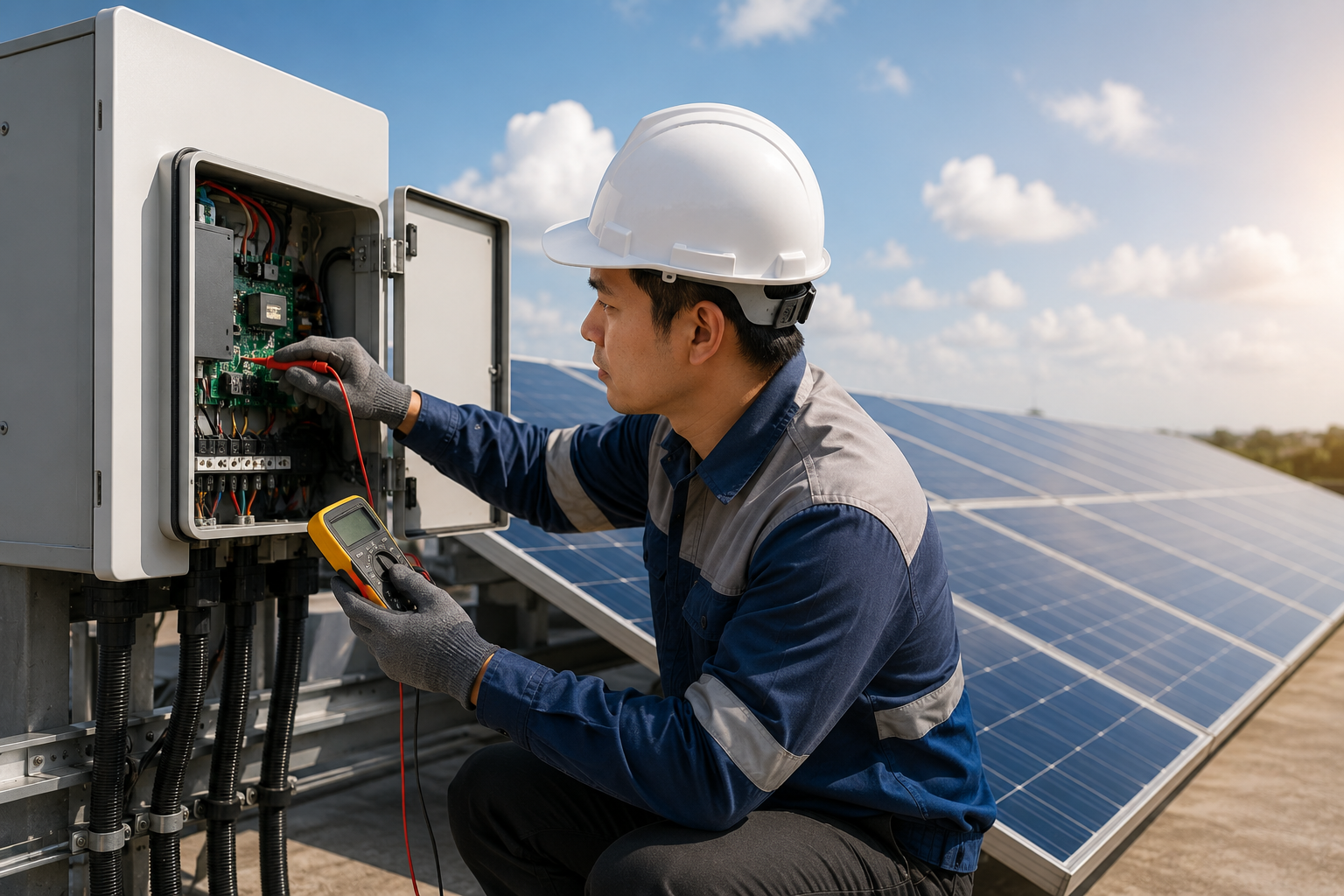
To maintain performance, recommended maintenance tasks include:
Cleaning the installation area
Checking cooling vents and fans
Monitoring software alerts
Inspecting cables and connectors
Measuring input and output parameters
Checking switching and surge protection devices
Updating software according to manufacturer instructions
Performing periodic maintenance as recommended by the manufacturer
Users should not open or repair an inverter themselves unless they have the appropriate electrical expertise.
An inverter should be inspected when any of the following signs appear:
Unexpected reduction in electricity generation
Repeated fault alerts
Frequent automatic restarts
Loss of connection to monitoring software
Excessive operating temperature
Battery charging or discharging failures
Limited output power
Unusual noise or abnormal operating conditions
Technicians should examine fault codes, solar string parameters, grid conditions, battery storage, and protection devices to identify the cause.
A solar inverter converts DC electricity from solar panels into AC power for local consumption or grid integration. It also optimizes solar output, monitors system performance, provides protection functions, and manages battery storage in hybrid configurations.
Choosing the right inverter requires evaluating the system type, solar panel capacity, string voltage, input current, MPPT configuration, installation conditions, and backup power requirements. A thorough site survey and integrated system design help ensure reliable solar power generation while simplifying maintenance and future expansion.
CATEGORIES
What Are the Main Components of a Solar Energy Storage System?
Solar Power System Design And Installation Process
How To Choose The Right Solar Panels
What Is A Solar Inverter? Its Role In A Solar Power System
When Should A Solar Power System Be Maintained?
How To Clean Solar Panels Properly
Signs That Your Solar Power System Needs Inspection Or Repair
Featured Products & Services
*YOU MAY ALSO LIKE
Contact us at Hotline: 0983 428 916 for consultation on solar energy equipment, system design, installation, and maintenance services.
Address: No. 105 Hoang Van Thai Street, Phuong Liet Ward, Ha Noi, Vietnam
Hotline: +84 983428916
Email: info@lochoangan.com
Loc Hoang An Tech specializes in consulting, designing, supplying equipment, and installing solar power systems for businesses, factories, industrial parks, commercial buildings, households, and civil construction projects nationwide.
LOC HOANG AN TECHNOLOGY GROUP JOINT STOCK COMPANY
Address: No. 105 Hoang Van Thai Street, Phuong Liet Ward, Ha Noi, Vietnam
Hotline: +84 983428916
Email: info@lochoangan.com
LOC HOANG AN TECHNOLOGY GROUP JOINT STOCK COMPANY
Địa chỉ: No. 105 Hoang Van Thai Street, Phuong Liet Ward, Ha Noi, Vietnam
Business Registration Certificate No. 0109587058 – Issued by the Department of Planning and Investment of Hanoi on April 07, 2021
Person responsible for content: Mr. Hien
@ Copyright by LOC HOANG AN TECHNOLOGY GROUP JOINT STOCK COMPANY. Designed by Vietnam Yellow Pages.